
Ajk Interim Act 1974 and Human Rights by Nadeem

May, 05 2025
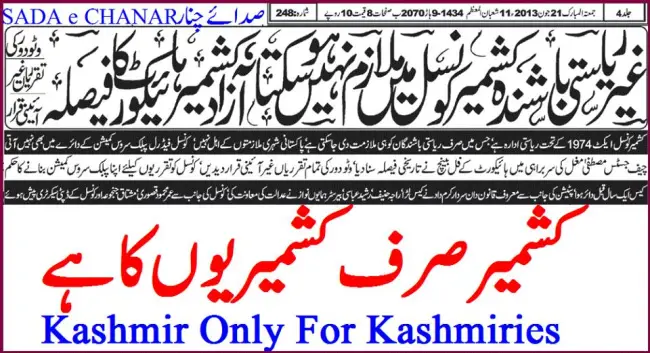
My submissions are as under: In 2010 the 18th Constitutional Amendment on Federation-Provinces Relations legislative and administrative responsibilities of the provinces in Pakistan, enables civil society of AJK to speak and proposed amendment’s in the AJK interim Act 0f 1974.Various NGO`S come forward and suggest their amendment’s to the AJK act 1974. AJK interim Act 1974, is a Pakistan`s colonial design for the people of Azad Kashmir (POK) to deprive them from the their fundamental rights and resources. The scope and aim of the Act is to protect the defacto occupational interests of military and civil establishment of Pakistan. The main aim of this legal frame work is to well control to the indigenous thoughts and struggle which represent the real interests of the people for their demand of national independence from Pakistan. The Kashmir council, ministry of Kashmir affairs to force the people of Azad Kashmir to believing Kashmir state accession to Pakistan, It is a crime if any Kashmir speaks, write against the occupied military of Pakistan and its agencies. These agencies are so powerful and above the preventive law in AJK. There is very low chances that people will empower through the amendments in AJK interim act 1974.Beacuse its design to support the Pakistan military occupation in AJK.There is no way to make military establishment accountable via this act AJKjudiciary and the legislature prove that they are the subservient of the GCO Muree and Islamabad. If we check progress of prosperity of life in AJK then its fail to prove that its progress is improving in any field of daily life. Injustice, corruption, unemployment, health, merit etc,its fail to achieve any substantial progress. The budget amount of AJK (nearly 56 Arab in Pak Rupee) is les then the amount spending CDA Islamabad Pakistan, the population of AJK is less than the Rawalpindi division of Pakistan. So the indigenous people those are standing to liberate the AJK,GB out rightly rejected the Act 1974.They want liberation (Azadi) and withdrawal of Pakistan army (weapons) from the territory of Kashmir .So there is no chance to enhance and propose any amendments which empower and protect the fundamental rights of the state subject holders of Kashmir . Because Pakistan is an author of this defacto document since 1966 to 2012.The various articles in Act 1974 are contrary to the fundamental human rights. As an estimate Government of Pakistan (WAPDA) owes around 255 billion rupees of profit of Mangla Dam to AJK since 1966. To understand the jurisprudence of the unlimited freedom of civil liberties and how people defend and protect their indigenous national and international fundamental rights. LAWS ENACTED BY THE GOVERNMENT OF AJ&K 1 1966 The AJ&K Grant of Khalsa Wastc Land as Shamlat Deh Act, 1966. (Act I of 1966) TO—————- 2009 The AJ&K Mangla Dam Housing Authority Act, 2009 (Act I of 2009) 2-Kashmiris are not a part of any UN resolutions and any bilateral Shimla Agreement which turn Kashmir a bilateral territorial dispute between India and Pakistan. Around 28 UN resolutions including the Shimla Agreement 2 July 1972 (between Z.A Bhutto and Indra Gandhi)and Elan-E-Lahore in 1992 (between A.B.Bajpi and Nwaz Sharief).India Pakistan are free to decide regarding Kashmiris in the name of regional peace and security. 3–The amendments (1-20) in the constitution of Pakistan were taken place during the struggle of the people of Pakistan past sixty years many lost their precious life during this struggle for the rule of law. Articles from 8-28 in the constitution of 1973 of Islamic republic of Pakistan cover the human rights. Where is any safeguard in AJK for the protection of fundamental rights? 4- Reaching up to the 18th – 20th amendments there was a Charter of Democracy on February 21, 2010 The 36 points Charter of Democracy signed by Benazir Bhutto(late) and Nawaz Sharif on May 14, 2006 in London UK. Remember Gen. Musharaf forced exile both former Prime ministers of Pakistan Benazir Bhutto and Nawaz Sharif (Now the prime minister of Pakistan) 5-Magna Carta also called Magna Carta Libertatum or The Great Charter of the Liberties of England, originally issued in Latin on 15 June 1215. 6- THE UN GENERAL ASSEMBLY PROCLAIMS THIS UNIVERSAL DECLARATION OF HUMAN RIGHTS On 10 December 1948 as a common standard of achievement for all peoples and all nations, to the end that every individual and every organ of society, keeping this Declaration constantly in mind, shall strive by teaching and education to promote respect for these rights and freedoms and by progressive measures, national and international, to secure their universal and effective recognition and observance, both among the peoples of Member States themselves and among the peoples of territories under their jurisdiction. 7-The European Convention on Human Rights The Governments signatory hereto, being Members of the Council of Europe, Considering the UNIVERSAL DECLARATION OF HUMAN RIGHTS proclaimed by the General Assembly of the United Nations on 10 December 1948. COUNCIL OF EUROPE, the European Convention on Human Rights ROME 4 November 1950, And its Five Protocols, PARIS 20 March 1952, STRASBOURG 6 May 1963, STRASBOURG 6 May 1963, STRASBOURG 16 September 1963, STRASBOURG 20 January 1966. To adopt and enhance a broader concept of human rights and accepting the fundamental right of independence and Kashmiris control of their own affairs and quash the status quo which maintain by the Pakistan and India and their proxies , subservient in all parts of divided occupied Kashmir .To accept the fundamental right to live as an independent country side by side with their neighbors peacefully without the presences of military and nuclear weapons .To subscribe broader approach is in a larger interest of Pakistan, India , Kashmir and the world at large. People of the region need a food, shelter, health and basic necessities of life. United, Independent, and socialist Kashmir is a best alternative solution for Kashmiris.
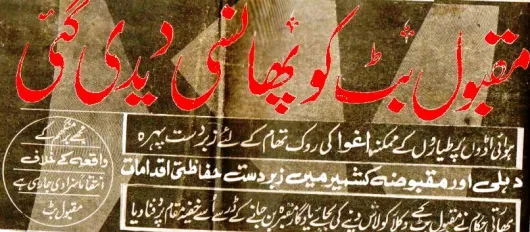
Return Maqbool Bhat’s Mortal Remains: A Challenge for Democratic, Secular Indiam
May, 05 2025
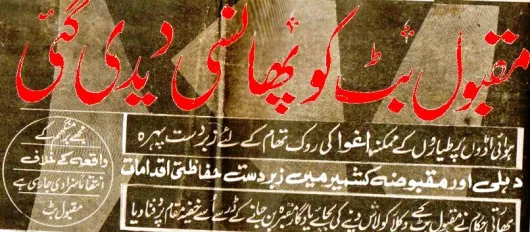
An Analysis of Maqbool Butt’s
Political Philosophy...
Nayyar Niaz Khan
May, 05 2025
The Political Philosophy of Maqbool Butt in His Own Words
Nayyar N Khan
Each month in Jammu Kashmir’s tempestuous political history tells us of nail-biting stories of death and despair but the month of February has distinctive inference in the great Himalayan Country of Jammu Kashmir. Many imperative political and non-political events transpired in the month of February. Some are still remembered and others elapsed with the merciless waves and tides of time but there is one date, which the people of Jammu Kashmir are not likely to disremember or forget for centuries to come. It is February 11.
On this day in 1984 a well-known Kashmiri revolutionary was sent to the gallows in India. On this day he became the legend of Jammu Kashmir for the present day political history. He is now known as the Shaheed-e-Azam, ‘father of the nation’, an icon of political resistance for many Kashmiri political groups across the divided Himalayan Country. His name is Maqbool Butt. He was the very first political warrior who got death sentence for the ongoing liberation struggle and due to his grand and noble stature among the masses across Jammu Kashmir, the forces of denials and cynics are dubbing his political philosophy and patching it for their own petty interests.
Many of his political comrades and innovators of the resistance movement in Jammu Kashmir are no more alive and unfortunately the younger generation cannot find much in written form to understand his political ideology. All those who had the opportunity to meet him remained faithful to his ideology unto the last breath of their life. His political character, visionary approach and passionate wisdom made him a charismatic and so dynamic personality that his name enshrines aloud and higher than Himalayas in the echoes of resistance across Jammu Kashmir.
His chronicled statements in the courts of Pakistan and India, speeches and contents of the letters to his family and friends which he wrote from the prisons are ample to understand his political wisdom. In 1970s while facing the charges of conspiracy against Pakistan at Lahore Special Court he made it very clear by stating that “Call it a coincidence or tyranny of the conditions, I have to stand today in this special court under a special order to defend the charges which are baseless and false. More appropriately these charges are the creation of a mind that is enemy of the freedom of my country and a cruel joke with the people of Jammu Kashmir who are fighting for liberation. History has given the verdict against those conditions and self-acclaimed rulers of Pakistan who have made me stand in this witness box. This verdict of history is so clear that no further explanation is needed. It has drawn a clear line between us and our hypocrite opponents. I take this proceeding as a compliment for myself and my comrades as future generations will have no confusion about our identity.”
In the above statement, he drew the line of demarcation between the mass resistance in Jammu Kashmir and propaganda of Pakistani establishment by calling them “enemy of freedom of my country and hypocrite opponents”. He further left it to history to judge his political character and made it clear to future generations of Jammu Kashmir to have no confusion about their political identification.
During the same hearing at Lahore Special Court, he said, “I have neither prepared any conspiracy nor been a part of any such group. My role is clear all the way through. However it is true that I have rebelled against obscurantism, slavery, capitalism, exploitation, corruption, cruelty, and hypocrisy. If the ruling class of Pakistan, which is a product of imperialist system and is represented by the civil and military bureaucracy, call it conspiracy then I have no hesitation to accept it.”
This part of statement was very much connected to his political philosophy where he attacked on all categories of exploitation and considered both capitalism and imperialism as the root cause of all the wrongdoings. By calling Pakistani rulers “a product of imperialist system” he connected himself with the international movements against slavery and exploitation across continents to overthrow colonialism and capitalism by achieving national liberation and establishing the form of governments free from all kinds of exploitation. Maqbool Butt knew that a revolutionary movement can only be successful when it is connected with the other movements across the globe having the same political ingredients. 1960s and 70s were indisputably the decades of national liberation and fight for social and economic justice across the continents. Therefore, it was obvious for a visionary like Maqbool Butt to be influenced by the great revolutionaries of the world like Che Guevara, Ho Chi Minh, Ahmed Bin Bela, Yassar Arafat and others, who were winning against colonialism and capitalism. Therefore, while making his statement in Lahore Special Court, Pakistan, he profoundly declared “during martial regimes, the armed struggles of Palestine, Vietnam, Algeria, Cuba and other African countries were presented as negative. The military rulers of Pakistan never supported a peoples’ armed struggle in Kashmir. They hated it as much as the Muslims of early period hated pig meat. It is this hatred of military rulers towards people’s armed struggle, which has made me and my comrades the target of brutal torture and humiliation.” By interconnecting the mass resistance in Jammu Kashmir and across the globe, he raised his stature from being a nationalist to a progressive internationalist who cared and supported the international movements for liberation and justice. And considered the resistance in Jammu Kashmir as the part and parcel of international movements against slavery, subjugation, exploitation and imperialism. Thus very rightly highlighted the “clash of classes” by challenging the ruling class of the region and categorically thrashing the class bonds between the ruling class of the region and across the globe. His political philosophy and his ideological connection with the international movements is very much clear in this part of his statement; “during human history whenever exploitation and slavery are challenged the ruling classes have always relied on the word ‘conspiracy’. But the history proves that in the fight of oppressed against oppressors, eventually the former won and the oppressive structure is crushed by the revolutionary struggle of the people. I have disliked self-praise but now when my role is being distorted, deliberately, I am forced to claim that at every stage of my life, I have not only supported the people’s struggle against exploitation and oppression but always actively participated in it.” This statement was made by Maqbool Butt when cold-war between two rivals was at peak across the globe and revolutionary camp was winning national liberations by aligning themselves with Soviet Union. Revolutionaries were not only overthrowing colonialism but they were also dumping off the rotten “system of governance” in their respective countries. Therefore, Maqbool Butt challenged to the judges of the court in Lahore by saying that “If the struggle for freedom was to be stopped by the court rulings there would have been hardly any free nation on earth today. If the evolution of civilization, democracy and freedom was to be prevented by the existing judicial or administrative system no revolution would have taken place from the beginning of history. Decisions about the movements for welfare and freedom of people are not made in the existing courts, instead it is the process of human history which gives the verdict on these government institutions. For the courts themselves are the product of the system that these movements are aimed to change.”
He was undoubtedly a practical man and not only the man of words. He believed in guerilla warfare to execute his political ideology because he was living in the era when Guerilla Warfare was used as a tool of resistance. He was well connected to his period of time and took all the necessary steps which were the norms of his time. He knew the paradigms of his political struggle and executed all the necessary measures to promote the concept of freedom among the suffering people of Jammu Kashmir. He was also well aware that the road to freedom always has impediments and is not an easy task rather a rocky road ahead. Therefore, he advised his nation by saying that “It is easy to talk about freedom. But it needs a lot more courage and patience to fight for freedom. This is the path where every turn is full of tests.”
He was a courageous warrior not only in political spheres also in the legal ones while defending the charges against him in Indian and Pakistani courts. When an FIR was lodged against him at Police Station Panzala, Indian held Kashmir (F.I.R. 38/66) charging Maqbool Butt with the murder of Amar Chand (a CID officer) and an agent of enemy (Pakistan), Maqbool Butt courageously replied to Judge Neil Kant Ganjo that “he accepts the charges of being an enemy of India for the reason that it had occupied my motherland; Mr. Justice “Call me an enemy I will accept the charges but remove the word agent as it is a disgrace to my political struggle for the liberation of my motherland” He is also referred to as saying ‘If Indian authorities of occupation think that by hanging me they can crush the Kashmir struggle they are mistaken. The struggle actually will start after my hanging.”
He always not only encouraged his companions rather warned them of opportunists within their own ranks by saying that “You go through such stages where your own friends on whom you relied, say no longer know you, of course for their own vested interests. They, even, leave you and make alliances with enemies. Struggle is the best criteria to judge not only who is for and against truth, but also to expose the hypocrites. It is not for freedom fighters to complain about the difficulties they face.”
After his arrest in Indian occupied Jammu Kashmir in 1966, he straightforwardly argued to the court questions. When asked by the court that he had illegally crossed over the ceasefire line from POK without lawfully obtaining the entry permit, he replied “he did not think it necessary to obtain a permit for moving around in his own country because to him the State of Jammu Kashmir is one country whether it is occupied by India or Pakistan” When asked by a journalist during the last days of his life about his successes and failures he unequivocally replied that “one cannot evaluate the failures and successes during his lifetime, if that was the case then Karl Marx and Jesus Christ would have been two failed leaders because they both had very little following during their life.”
He left a very solid message for his nation by declaring that “it is my faith that the dawn of freedom will fall in my country and the line of division will be trodden upon. This will be the time when facts about my life will come out. Only then I will get justice and this will be done in the court of history. That day my people will know the reality of the allegations, by both the Indian and Pakistani rulers against me, of being an agent of India or Pakistan.”
It is now up to the younger generations of this divided Himalayan country of Jammu Kashmir who love to carry his portraits while chanting for “Azadi” whether they understand the real meanings of “Azadi”, Maqbool Butt sacrificed his life for? If they understand, then they definitely need to rebel against obscurantism, slavery, capitalism, exploitation, corruption, cruelty, and hypocrisy. (Nayyar N Khan is a US based political and human rights activist and a freelance journalist. His area of concentration is International Peace and Conflict Resolution. He can be reached at globalpeace2002@hotmail.com)